

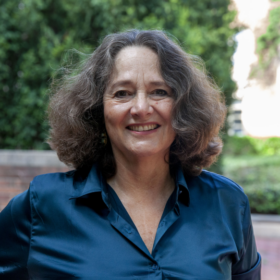
Maite Zubiaurre
Chair and Professor
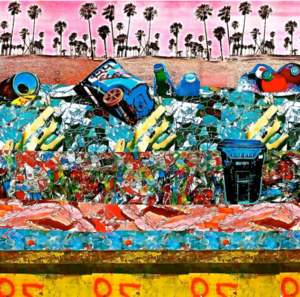 “Trashscape Venice Beach” (Filomena Cruz, 2016)
MAITE ZUBIAURRE is a professor in European Languages and Transcultural Studies (ELTS) and Spanish and Portuguese, UCLA. She is an acclaimed and Oscar-shortlisted filmmaker and scholar, whose work explores memory, loss, and identity across borders, with a sustained focus on marginalized communities. Committed, as scholar and documentary filmmaker, to the publicly engaged humanities, Zubiaurre is also a visual artist and artivist, under the name of Filomena Cruz.
Zubiaurre is the co-director, co-writer, and co-producer, with Kristy Guevara-Flanagan, of Aguilas/Eagles, an Oscar-shortlisted and multi-awarded short documentary that tells the story of “Aguilas del Desierto,” a humanitarian organization that searches for missing migrants in the Southern Arizona desert. She is also the lead director, co-writer, and co-producer, with Jae-An Crisman, of the feature documentary Jovita y Valentín, a feature documentary on the forensic identification and repatriation of deceased migrants and is directing a feature documentary currently in production on street artists in Venice Beach, California.
Maite Zubiaurre initiated her career as literary translator from novels in German into Spanish (among them, Theodor Fontane’s Der Stechlin) for the renowned publisher Alfaguara. She holds a degree in Comparative Literature from Columbia University, and taught at USC (University of Southern California), ITAM (Instituto Tecnológico Autónomo de México), UNAM (Universidad Nacional Autónoma de México), and the University of Texas, Austin, before joining the Department of Spanish and Portuguese and the Department of European Languages and Transcultural Studies (ELTS), her home department, at UCLA.
Her areas of expertise are Comparative Literature; literary translation; contemporary Iberian and German literature and culture; discard studies; migration and border studies; gender and sexuality studies; urban studies; cultural studies; visual studies; and contemporary Mexican letters and cultural studies.
Zubiaurre is currently co-PI and core faculty of the Urban Humanities Initiative (UHI) and PI of MARKINGS: Inscribing Indigenous Immigrant Histories in Westlake. She participated as co-PI in the Sawyer Seminar on “Sanctuary Spaces: Reworlding Humanism, and is a longstanding member of the Faculty Advisory Committee of the Program in Digital Humanities.
Zubiaurre is the author of El espacio en la novela realista. Paisajes, miniaturas, perspectivas (Fondo de Cultura Económica, 2000), a book-length study of the dialectics of space and gender in European and Latin American realist fiction, and of Cultures of the Erotic in Spain 1898-1939 (Vanderbilt University Press, 2012), the first scholarly monograph that analyzes the diverse visual and textual representations of the erotic in Spanish popular culture during the so-called “Edad de Plata” or Silver Age (1898-1936). Maite Zubiaurre’s adaptation and translation into Spanish of Cultures of the Erotic –Culturas del erotismo en España 1898-1939— was published by Cátedra in 2014.
Zubiaurre is the creator of A Virtual Wunderkammer: Early Twentieth-Century Erotica in Spain, a comprehensive virtual repository that serves as a digital companion to her scholarly monographs, Cultures of the Erotic/Culturas del erotismo. An ongoing comprehensive virtual archive of fin de siècle Spanish erotica, unique in its kind, it houses more than 500 images and a rich array of fully scanned texts, among them more than 100 works on sexology and sexual hygiene; close to 100 erotic magazines; around 120 magazines and works on nudism; and more than 240 erotic novelettes.
Zubiaurre has penned numerous articles and critical editions (among them, a feminist critical edition of Leopoldo Alas “Clarín’s” masterpiece, La Regenta) and is the co-editor, with Roberta Johnson, of an anthology of Spanish feminist thought (Antología del pensamiento feminista español: 1726-2008, Cátedra, 2012).
Her scholarly monograph, Talking Trash. Cultural Uses of Waste (2019) won the Vanderbilt University Press 2020 Norman L. and Roselea J. Goldberg Prize for the best book in the area of art or medicine. Her own adaptation and translation into Spanish, Basura. Usos culturales de los desechos, was published by Cátedra in 2021.
She is the co-author, with Dana Cuff, Anastasia Loukaitou-Sideris, Todd Presner, and Jonathan Crisman, of Urban Humanities. New Practices for Reimagining the City (MIT Press, 2020), a scholarly monograph that proposes original, action-oriented, and social and spatial justice-driven humanist practices for interpreting and intervening the urban landscape. Zubiaurre is also co-editor of Public History in Mexico. Memories, Displacements, and Intimacies (Routledge, 2026), an exploration of the impact of memory, resilience, and community-driven interventions in urban and marginalized spaces across Mexico.
Filomena Cruz, the artivist and collagist alter ego of Maite Zubiaurre, created the ongoing urban intervention The Wall that Gives/El muro que da (2016–present) and co-created Mujer Migrante Memorial (MMM), an onsite and virtual installation honoring migrant women who perish crossing the Arizona desert. She also directed the short documentary Mujer Migrante Memorial, which brings the installation to film.
Education
- PhD in Comparative Literature, Columbia University