

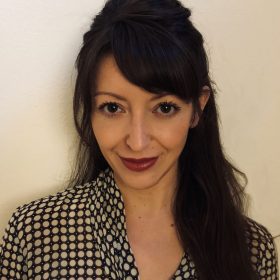
Kalani Michell
Assistant Professor
Office Hours: Mon, 9:00am-11:00am
Fields of interest: Film and Media Studies; Media Theory and Historiography; Installation and Performance ArtKalani Michell is Assistant Professor in the Department of European Languages and Transcultural Studies at the University of California Los Angeles. Prior to this, she worked as a postdoctoral fellow in the research collective (Graduiertenkolleg) “Configurations of Film” and as an Assistant Professor (wissenschaftliche Mitarbeiterin) in Media Studies at the Goethe University Frankfurt. She has taught and written about a wide range of media, including photography, comics, installation and performance art, print culture, film and media theory, sound studies, and media historiography.
Her monograph, Working Title: Media Packaging and the Margins of Art, recently published with University of California Press, is about all the supposedly mundane things involved in creative work that you’re not supposed to talk about, and the rhetoric of the talk itself: the prerequisites, formalities, long waits, copyright battles, packaging dilemmas, and project pitches (like the one you’re reading now). Media processes typically understood as merely peripheral to a discrete and more valuable “work of art” in the making. But why might we be hesitant to openly acknowledge the range of legitimating operations, better alternatives, microdecisions, and false starts that affect the conditions of possibility for “actual” creative artistic work? This book helps visualize the messiness and indiscreetness of the creative process by attending to such crucial, if often overlooked media processes and their influence on canonization and institutionalization. It delves into European and transatlantic audiovisual media from the 1960s and 1970s, including performances, visual art, installations, and films, which might seem well-known to us as avant-garde artworks from “the past.” But in this book, they don’t remain there. Exploring the less visible media among these works – from video games, photography, television, and YouTube videos to legal texts, containers, rubbish, and paperwork – Working Title unsettles the familiar motivating mythologies of art of this era and makes space for the heavy lifting these media do, carving out what and how they mean for us today and revisiting their forgotten futures.
In addition to working on this project, she has published on a variety of art and media topics, such as the circulation of the Mona Lisa in the set design of pornographic productions (in CineAction), the emergence of academic podcasts in film and media studies (in Format Matters), and conformist expectations of captions for photographs and film stills in scholarly texts (in New Perspectives on Academic Writing). Her research on German cinema has examined concepts of surveillance, memory, and home movies in Thomas Heise’s Barluschke (in East, West and Centre), invisibility techniques in a sci-fi film from the Third Reich (in Continuity and Crisis), and the comics storyboard and sketch aesthetic in Christian Petzold’s filmic shot composition (in Storyboarding). Her latest research projects focus on the backside of paintings, disciplinary yearbooks, and video conferencing interfaces: the Antiguan studio photographs on the versos of Frank Walter’s miniature European landscape paintings (in liquid blackness), ways of reassembling a collective image of disciplinary belonging by emphasizing questions of reception in German-speaking contexts (in New German Critique), and the epistemic values inscribed into new media environments of remote learning (in Video Conferencing).
Education
- Ph.D. University of Minnesota. German Studies and minor in Moving Image Studies
- M.A. University of Minnesota. German Studies
- B.A. University of Nevada, Reno. German Studies and International Affairs
Selected Publications
Articles
- “A Study Abroad during Covid-19,” in Video Conferencing: Infrastructures, Practices, Aesthetics, eds. Axel Volmar, Olga Moskatova, and Jan Distelmeyer (Bielefeld and New York: Transcript Verlag and Columbia University Press, 2023), 45-68.
- “‘The 62 Members of the Mickey Mouse Club’: Yearbook Impressions,” in New German Critique 50, no. 3, “Fiftieth Anniversary Issue: Possibilities and Provocations” (2023), 133-148.
- “Photography on Tilt,” in liquid blackness: journal of aesthetics and black studies 7, no. 2, issue on “Suspension” (2023), 61-85.
- “[Fill in the Blank],” in New Perspectives on Academic Writing: The Thing That Wouldn’t Die, Bernd Herzogenrath (New York: Bloomsbury, 2022), 61-83.
- “Royce Hall,” in Thomas Mann’s Los Angeles: Stories from Exile 1940–1952, eds. Nikolai Blaumer and Benno Herz (Los Angeles: Angel City Press, 2022), 34-37.
- “Pod Fictions,” in Format Matters: Standards, Practices, and Politics in Media Cultures, eds. Marek Jancovic, Alexandra Schneider, and Axel Volmar (Lüneburg: Meson Press, 2020), 253-279.
-
“Revolting Formats: Hellmuth Costard’s Der kleine Godard. An das Kuratorium Junger Deutscher Film” (The Little Godard: To the Production Board for Young German Cinema), in Celluloid Revolt: German Screen Cultures and the Long 1968, eds. Christina Gerhardt and Marco Abel (Rochester: Camden House, 2019), 253-267.
-
“Comic Storyboardkonstruktionen. Petzolds Angriffsflächen” (Comic Storyboard Constructions: Petzold’s Surfaces of Intervention), in Storyboarding: Filmisches Entwerfen (Storyboarding: Filmic Design), eds. Jan Henschen and Anna Häusler (Marburg: Schüren, 2017), 127-147.
- “Seeing Crisis in Harry Piel’s Ein Unsichtbarer geht durch die Stadt (1933)” (An Invisible Man Goes through the City), in Continuity and Crisis in German Cinema 1928 – 1936, eds. Valerie Weinstein, Mihaela Petrescu, and Barbara Hales (Rochester: Camden House, 2016), 251-269.
-
“Barluschke: Toward an East West Schizo-History,” in East, West and Centre: Reframing Post-1989 European Cinema, eds. Michael Gott and Todd Herzog (Edinburgh: Edinburgh University Press, 2015), 253-266.
- “I Know It When I See It: Mona Lisa on the Move,” in CineAction 91, issue on “Film+Art” (2013), 50-57.
- “Anstehen mit Foucault,” (In Line with Foucault) in kultuRRevolution – Zeitschrift für angewandte Diskurstheorie (Cultural Revolution – Journal of Applied Discourse Theory) 64, issue on “Foucault und/oder Ideengeschichte” (Foucault and/or the History of Ideas) (2013), 58-68.
- “Drei (und mehr) Arten, Tinte ans Laufen zu kriegen” (Three-Plus Ways of Reanimating Ink) in Re-Animationen: Szenen des Auf- und Ablebens in Kunst, Literatur und Geschichtsschreibung (Reanimations: Scenes of Re- and Degeneration in Art, Literature and Historiography), eds. Ulrike Hanstein, Anika Höppner, and Jana Mangold (Cologne/Weimar: Böhlau Publishers, 2012), 281-310.
Reviews
- “Animierte Bildkulissen” (Animated Backdrops). Rev. of Curtains (2014) by Lucy Raven at the Portikus Exhibition Hall, in Texte zur Kunst (Texts on Art) 97, issue on “Bohème” (2015), 183-186.
- Rev. of New Austrian Film, eds. Robert von Dassanowsky and Oliver C. Speck, in Austrian Studies Newsletter 23, no. 2 (2011), 17-18.
Courses commonly taught
Undergraduate Courses:
- Ger 102: Where’s Europe?
- Ger 103: Comedies, Melodramas, and Snow White in the Third Reich
- Ger 104: German Films You Won’t Find at the Oscars
- Ger 104: Unradical German Films of the 1960s/1970s
- Ger 110: What’s Happening in German Media Studies?
- Ger 103: Lubitsch Touch-Quatsch
- Ger 110: Media Environments and German Palm Tree Dreams
- Ger 112: Austrian Film and Feminisms
- Ger 191A: Speculative Ways of Writing History
- Ger 104: Writing in German Film
- Ger 159: Transatlantic Bauhaus
Graduate Courses:
- Ger 261: Comparative Media Studies
- Ger 263: Where is Photography?
- Ger 213: Paperwork in Film Work
- ELTS 208: Documentary Media
Honors and Awards
- Research Allowance Program Grant (2025-2026)
- Council on Research Faculty Grant (2024-2025)
- UCLA Society of Hellman Fellows award (2022-2023)
- Council on Research Faculty Research Grant (2022-2023)
- EPIC Mellon Fellow for Environmental Humanities Seminar in Teaching Excellence (2022)
- Council on Research Bridge Research Grant (2021-2022)
- Faculty Career Development Award (2020-2021)
- Council on Research Faculty Research Grant (2020-2021)
- Fulbright Research Grant (2014-2015)
- Harold Leonard Memorial Fellowship in Film Study (2013-2014)
- Center for Austrian Studies Research Fellowship for archival project on Valie Export (2013)
- Hella Lindemeyer Mears Fellowship (2010-2011)
- Center for German and European Studies Fellowship for the Leo Baeck Summer University in Jewish Studies (2009)
- Max Kade Fellowship (2008-2009)
- Fulbright Scholar (2007-2008)
Professional Activities
- Johannes Gutenberg University Mainz, Vertretungsprofessorin (Interim Professor) for Film Studies, Summer Semester 2022
- Member of the Chicano Studies Research Center Faculty Advisory Committee (2020-present)
- Editorial board member of Configurations of Film book series with Meson Press (2019-present)